References
FORRT AI in Metascience · Tuesday 29 September
Getting our hands dirty
Agentic reproductions and robustness checks
Lukas Wallrich, Birkbeck, University of London
The next 70 minutes
Plan
StartA live run on a preprint of mine: we start it now.
AgentsHow coding agents work, and how to work with them.
CasesThree papers, four agents, one prompt each: what came back, and where the agents disagree.
LiveBack to the live run: what it found, and one choice tested.
LastWhat still needs a human, then discussion.
Try it out with your own or a relevant paper, or just watch.
Live · started now, back at the end
A live run on a preprint of mine
Not in any training data, and I know where it is fragile: osf.io/preprints/psyarxiv/jsbgu
Consider the preprint at https://osf.io/preprints/psyarxiv/jsbgu and its linked data and code. Reproduce all numbers reported in it, with one script that runs from a clean start. Then identify the 3–5 analysis choices that are most fragile, list them, and predict what changing each might do to the results. Do not run those alternatives yet.
- It finds the data and code and reproduces the numbers while we talk.
- It lists the fragile choices, with predictions.
- At the end, I pick one, and it tests it.
Follow along
Try it yourself
lukaswallrich.github.io/
ai-metascience-hands-on
Pick your own paper or a relevant one with open data and code, or one of our three cases.
You need an agent you already use (Claude Code, Codex, OpenCode) and R or Python.

While they run
Working with coding agents
What an agent does, how to run several at once, and how to write a prompt it can work with.

How an agent works
Getting AI to run in circles
your
goal ›
› final
answer
goal ›
LLM
proposes the
next command
next command
——› command "Rscript model.R"
‹—— result "coefficient table"
Your machine
runs it, sends
back the result
back the result
answer
↻ repeat until the goal is met. The LLM only ever writes text; your machine does the doing.
Tools it can call
read part of a file
search the web
search your files
edit a file
run code
ask you a question
The interface today
One window, several agents
T3 Code is a free, open-source desktop (and web) app from Ping.
- One interface for coding agents such as Claude Code, Codex and OpenCode.
- You sign in with your own accounts, so you pay the agent providers as usual.
- Each run is a thread, with a diff viewer for the files it changed.
The agents work fine in a terminal or in their own apps. T3 Code is a convenience. t3.codes
Choosing
Which agent?
Claude Code
Anthropic's agent. Comes with a Claude subscription. Paid plans start at about $20/month.
Codex
OpenAI's agent. Comes with a ChatGPT subscription. Paid plans start at about $20/month.
OpenCode
Open-source agent. Works with many model providers (paid per use) or with local models. Today with DeepSeek Flash.
The models change every month. The habits on the next slide carry over.
Behind the prompt
Four habits, in this prompt
Context
The paper, with its linked data and code.
"Consider the preprint at [URL] and the linked supplementary data and code"
Grounding
One script that runs from a clean start.
"one script … produces every number you report"
Plan/questions
List the alternatives and predictions before running them.
"Before running anything, list 6–10 alternative choices"
Verify
Published vs. reproduced, with the source of each number, and a list of decisions.
"say where you got it"
Before you try it on your own data
Can I use AI with my data?
Easy
Published open data, like today's two cases.
With care
De-identified data you are allowed to share.
Never*
Identifiable participant data.
* without a data processing agreement (and ethics approval), e.g. an enterprise contract or an approved secure environment, or a fully local model.
Case A · small, agents finish in a few minutes
"Female hurricanes are deadlier than male hurricanes"
92 US hurricanes, 1950–2012. Storms with more feminine names killed more people.
The authors' explanation: people take a storm with a feminine name less seriously.
The data are open. use them as a worked example for specification curve analysis.
, PNAS, 111(24), 8782–8787.
Case B · larger, many analysts
Do referees give more red cards to dark-skin-toned players?
29 teams analysed the same data: 146,028 player–referee pairs.
0.89 – 2.93
range of odds ratios (median 1.31)
20 of 29
teams had a confidence interval that excluded 1
Too slow to run live. In last night's runs, the agents saw this spread only after finishing their own analysis.
, AMPPS, 1(3), 337–356. Numbers from the teams' estimates file on OSF.
Case C · recent: published January 2026
Does researchers' ideology shape their findings?
71 teams in a many-analysts study of immigration and support for social policy produced 1,253 estimates.
+0.085
pro- minus anti-immigration teams' estimates (p = .008)
+0.011
per point of team pro-immigration sentiment (p = .06, tested at the 10% level)
The agents get the authors' replication package as published, and are told not to search for comments on the paper.
, Science Advances, 12(1), eadz7173. Data from .
The prompts in short (full text on the page)
What each agent gets
The data with its documentation (for case C, the whole replication package), and the paper's reference and DOI. Then:
Cases A and C · hurricanes, ideology
- Reproduce the main result, with one script that runs from a clean start.
- Compare with the published numbers, and say where each came from.
- List the decisions the paper left open.
- Stress-test: predict, then run 6–10 alternatives.
- Judge whether the claim holds up.
Case C adds: do not search for comments on the paper.
Case B · red cards
- Answer the question your way, with one script and an odds ratio.
- List the decisions the data left open.
- Stress-test: predict, then run 6–10 alternatives.
- Only then compare with the 29 teams.
- Conclude.
The runs
Four agents, same prompt
- Claude Opus 5.5 and Fable 5.1, in Claude Code
- Codex GPT-6 Sol and Astra
- DeepSeek Flash, through OpenCode
Ran unattended last night and this morning, all through T3 Code. All reports: …/ai-metascience-hands-on/reports
Before we look at results
A caveat: famous papers are in the training data
Asked from memory: no files, no web
All three agents recalled Silberzahn's numbers: 29 teams, odds ratios 0.89–2.93, 20 significant.
All three knew the main critique of the hurricane paper: before 1979, every Atlantic hurricane had a female name. Given the data, all three then tested exactly that.
What to do
The prompt asks for the source of each published number.
For real checks, use material the model cannot have memorised: your own work, or recent work like case C. Asked from memory, no agent could give its estimates.
Back to the runs
What came back
The report, the script, and the trace of what each agent did.
Case A · results from last night's runs
Same coefficients, different headlines
| Published | Opus 5.5 | Fable 5.1 | Codex | DeepSeek | |
|---|---|---|---|---|---|
| Name × damage | 0.705 | 0.705 | 0.705 | 0.705 | 0.705 |
| Its SE | 0.184 | 0.184 | 0.150 | 0.184 | – |
| Paper read from | PubMed Central | PubMed Central | a PDF on a cycling blog | PubMed Central | |
| Deaths, feminine vs masculine name, severe storm | ×2.8 high vs low damage split | ×2.8 median split, as the paper | ×5.1 damage +1 SD | ×1.5 75th percentile | ×2.8 median split, as the paper |
The coefficients reproduce exactly. The paper does not say where "severe" starts, so each agent chose its own point.
Claude Opus 5.5 (high, 29 Sep) and Claude Fable 5.1 (Claude Code) · GPT-6 Sol, high effort (Codex) · DeepSeek Flash (OpenCode), 28 Sep.
Case A · results from last night's runs
Which robustness checks did they choose?
| Does the effect survive… | Opus 5.5 | Fable 5.1 | Codex | DeepSeek |
|---|---|---|---|---|
| only storms from 1979 on | no | no | no | no |
| log damage | no | no | no | – |
| no interaction terms | no | no | – | no |
| binary name gender | yes | yes | yes | yes |
| dropping the deadliest storms | – | yes | yes | – |
| the other pressure variable | yes | yes | yes* | yes* |
Each ran 9–10 checks and concluded that the claim is fragile. All four chose the 1979 split, the best-known critique of the paper.
Each agent judged "survives" by its own yardstick. * Both followed an error in the data's documentation.
Case B · results from last night's runs
Three analysts, three answers?
| Claude | Codex | DeepSeek | |
|---|---|---|---|
| Model | mixed model, player & referee random effects | logistic, clustered SEs | logistic, clustered SEs |
| Outcome | red cards | red cards + second yellows | red cards |
| Skin-tone contrast | very light → very dark | 0.25 → 0.75 | very light → very dark |
| Odds ratio [95% CI] | 1.38 [1.12, 1.70] | 1.12 [1.03, 1.22] | 1.34 [1.10, 1.62] |
| Time to finish | about 1 hour | 8.5 min | 51 min |
Codex's estimate covers half the scale. Over the full scale it is about 1.26, close to the others.
Case B · results from last night's runs
Where the agents fall among the 29 teams
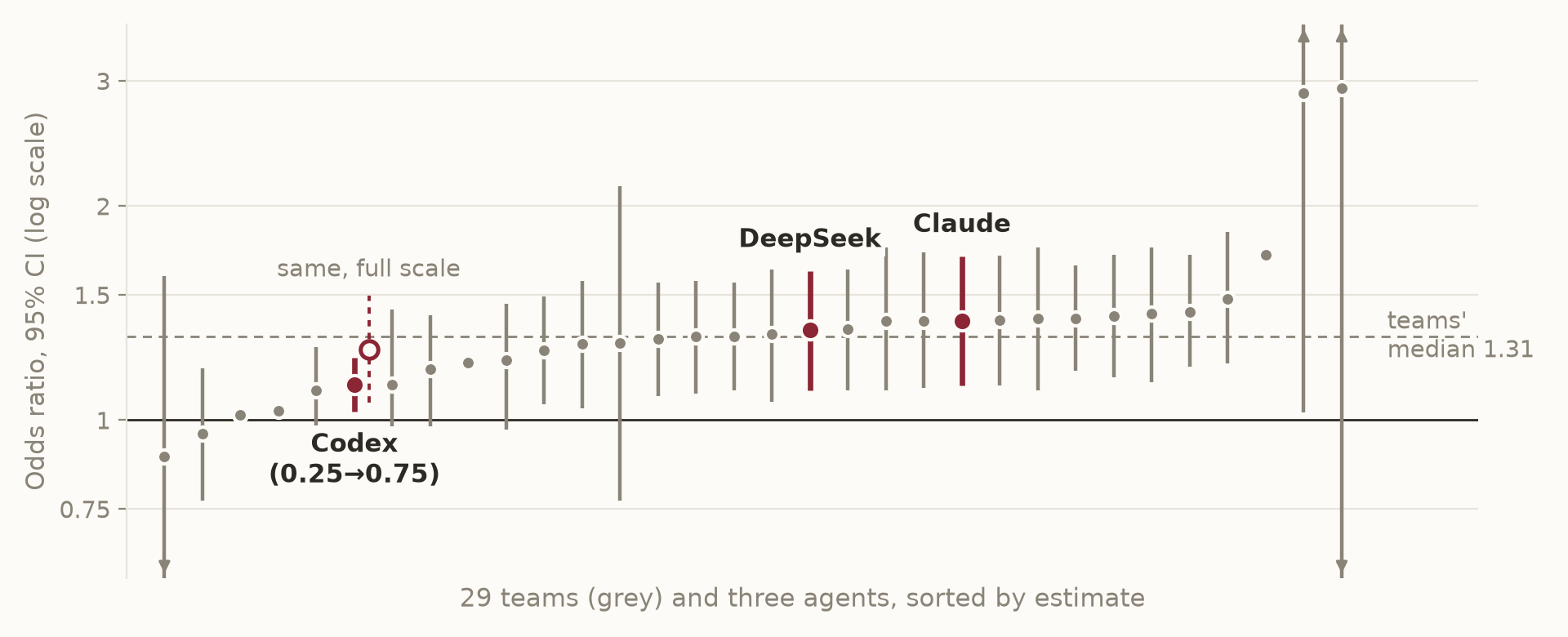
Codex placed its 1.12 below 24 of the 29 teams, while noting that their contrasts differ.
Case C · results from this morning's runs
Four agents, the same replication package
| Opus 5.5 | GPT-6 Astra | GPT-6 Sol | DeepSeek Flash | |
|---|---|---|---|---|
| Reproduced Table 1 | all 9 columns | all 9 columns | all 9 columns | all 9 columns |
| Noticed 4 discipline codes with one team each | yes: "the paper does not discuss this" | yes, as a technical nuisance | no | no |
| Verdict | "weaker than Table 1 suggests" | "depends on defensible analysis choices" | "depends on reasonable analysis choices" | "holds up" |
All four chose the pro–anti contrast (p = .008) as the main result. In every run, removing the discipline controls (alone or with all others) made it non-significant.
Claude Code, Codex (both on high effort) and OpenCode, 6.5–11 minutes each.
Case C · what the replicators found
Two agents saw the problem. None ran the check.
- Four discipline codes each hold one team. Their fixed effects absorb 80 estimates that go against the hypothesis .
- Merge those four codes, and the per-point effect falls from 0.011 (p = .06) to 0.001 (p = .94). The agents' pro–anti contrast falls from 0.085 (p = .008) to 0.044 (p = .23).
- Dropping the weights, or using the original study's standardised estimates, also removes the per-point effect.
- The authors reply that their discipline coding is a theory-driven choice .
All three cases
What each agent decided without being asked
- Trusting the documentation. The data's documentation describes one variable wrongly. Claude checked the data and noticed; Codex and DeepSeek built on the error.
- Where "severe" starts. A median split, 1 SD above average, or the 75th percentile of damage: death ratios from ×1.5 to ×5.1 from one model.
- What counts as a red card. Codex added second yellows; the others did not.
- How far apart to compare. DeepSeek concluded that a dark/light split "removes the association". Codex ran the same split and flagged that it measures a different contrast.
- What the main result is. In case C, all four agents chose the contrast with p = .008 over the per-point effect with p = .06.
Live · back to the preprint
What did the live run find?
- Which numbers did it reproduce, and which not?
- Which fragile choices did it list, and what did it predict?
- I pick one choice. It tests it, and we compare with its prediction.
What still needs a human
- Deciding what counts as the "main result" before the agent does.
- Checking where each published number came from: the paper, or memory.
- Judging whether an alternative analysis is defensible, or only different.
- Following up an oddity the agent reports: does it change the result?
- Rerunning the script and reading the code, especially the data cleaning.
At this conference · all times CEST
Later today and tomorrow
Tue 14:40Predicting replicability
Tue 16:05Machines that build and test the replication record (incl. ReplicatorBench; at 17:15: "Can an agentic LLM run computational reproducibility checks at human quality?")
Wed 15:00Does the finding survive another analyst? (incl. PaperRobust and "Multiverse Analysis in the Age of Large Language Models")

Slides made with Claude Code · illustrations generated with gpt‑image‑2, via Claude Code.